
 See My Latest Article on HelloNation
A stamping die is a precision tool that cuts, bends, forms, or draws sheet metal into a specific shape. The die works inside a stamping press, where controlled force moves one tool half toward another and transforms flat material into a repeatable part.
For residents and manufacturers in Rochester, NY, metal stamping may be behind many everyday objects, including electrical brackets, appliance components, hardware, vehicle parts, and building-system fittings. Although a finished stamped part can look simple, the die that creates it may require careful engineering, machining, heat treatment, and testing.
What exactly is a stamping die?
A stamping die is a matched set of hardened tool components designed to perform a specific operation on metal. The upper portion is commonly attached to the press ram, while the lower portion is secured to the press bed.
As the press closes, the die applies force to sheet metal or another form of flat stock. Depending on its design, it may:
- Cut a part from the sheet
- Punch holes or slots
- Bend a flange
- Form a three-dimensional contour
- Draw flat material into a cup or enclosure
- Perform several operations in sequence
The term “die” can describe the entire tool assembly or a particular forming component. A punch is the male element that enters or presses against the material, while the die cavity supports or receives the material during the operation.
How does a stamping die work?
A stamping die works by controlling where metal is cut, supported, compressed, stretched, or bent. The press supplies the force, but the die determines how that force is transferred into the material.
For a basic piercing operation, a punch pushes through sheet metal while a matching die opening supports the surrounding material. The small space between the punch and die opening is called clearance. Proper clearance helps produce a clean edge without excessive burrs, cracking, or tool wear.
For bending, the die includes surfaces that guide the sheet into a new angle or shape. For drawing, the material flows into a cavity while a blank holder helps control wrinkling. More advanced dies may combine piercing, bending, forming, and cutoff in one tool.
The press stroke, speed, tonnage, material thickness, and lubrication all affect the result. A well-designed die must account for these factors rather than relying on force alone.
What are the main types of stamping dies?
Different part shapes and production requirements call for different die designs.
Single-operation dies
A single-operation die performs one primary task during each press stroke, such as cutting a blank or making a hole. These tools are relatively straightforward and may be useful for low-volume work, development projects, or parts requiring separate operations.
Compound dies
A compound die performs multiple cutting actions in one press stroke, usually while the material remains in one position. For example, it may cut an outside profile and pierce an internal opening at the same time.
Progressive dies
A progressive die carries out several operations as a strip of material advances through stations within the tool. One station may pierce holes, another may bend a feature, and a later station may separate the finished part.
Progressive dies can produce complex parts efficiently, but they require accurate strip layout, alignment, feeding, and timing. Small design errors can affect every station.
Transfer dies
Transfer dies move individual blanks between forming stations. They are often used for larger or deeper parts that cannot remain connected in a continuous strip.
Forming and drawing dies
These tools shape metal without simply cutting it away. They are used for channels, shells, covers, brackets, and other three-dimensional forms. Deep drawing requires careful control because excessive stretching can thin or tear the material.
How is a stamping die made?
Making a die begins with understanding the finished part and the material from which it will be produced. The process usually follows several connected stages.
1. Part and process design
Engineers review the part’s dimensions, tolerances, material grade, thickness, bend radii, hole locations, and expected production volume. They also determine whether the part should be made in one operation or divided among several stations.
The design must consider springback, which is the tendency of bent metal to partially return toward its original shape after pressure is removed. Bend allowances and forming compensation are added so the final part reaches the intended dimensions.
2. Die layout and engineering
The die layout shows how the part will move through the tool. In a progressive die, this includes the strip width, feed direction, carrier sections, station spacing, and sequence of operations.
Computer-aided design and forming simulations may be used to identify areas where material could wrinkle, split, distort, or interfere with the tool. The design also specifies guide posts, plates, springs, retainers, punches, inserts, and safety clearances.
3. Material selection
Die components are made from tool steels or other wear-resistant materials selected for the job. High-volume production generally requires harder, more durable components than short-run tooling.
Different sections may use different materials. Cutting punches and die inserts need strong wear resistance, while plates and structural components must maintain stiffness and alignment. Heat treatment can increase hardness and improve service life, but excessive hardness may make a component more vulnerable to cracking.
4. Machining the components
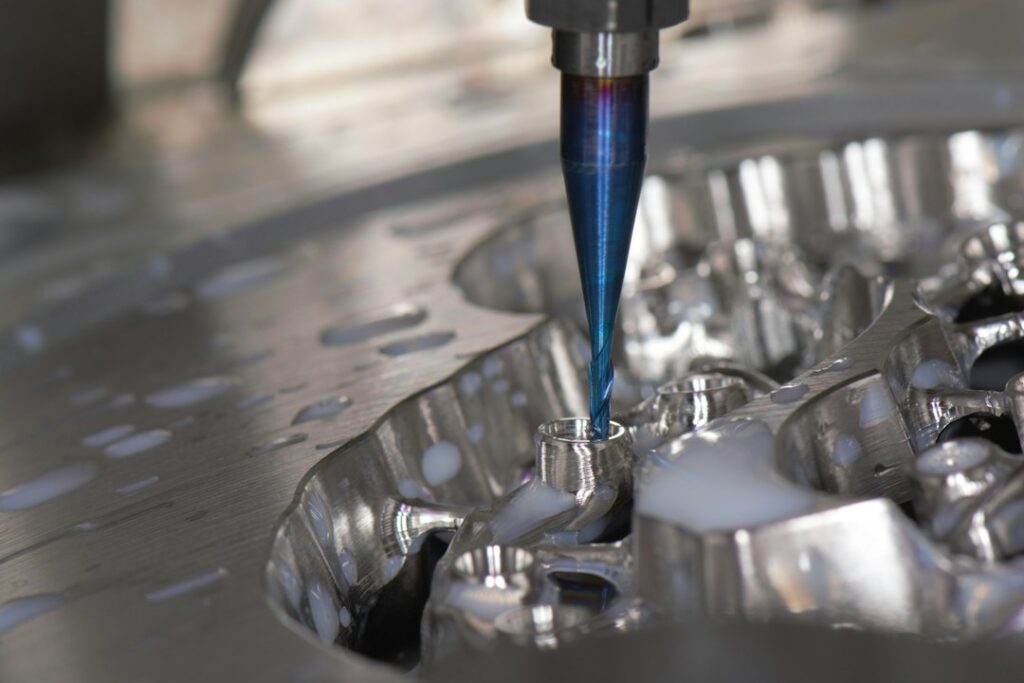
Large blocks and plates are cut and machined to create the die set. Common processes include milling, turning, drilling, grinding, and electrical discharge machining.
Electrical discharge machining, often called EDM, uses controlled electrical discharges to remove metal. It is useful for producing narrow slots, intricate profiles, and hardened features that would be difficult to machine with conventional cutting tools.
Precision grinding brings critical surfaces to their required dimensions and finish. Proper alignment is essential because even a small mismatch between a punch and die opening can produce poor edges or damage the tool.

5. Heat treatment and finishing
Selected components are heat-treated to achieve the required hardness and stability. After heat treatment, parts may be ground again because the process can cause slight dimensional changes.
Some dies also receive coatings or surface treatments to reduce friction, resist wear, or improve performance with difficult materials. The treatment must match the metal being stamped and the operating conditions.
6. Assembly and tryout
The completed components are assembled with guide systems, springs, retainers, fasteners, and replaceable inserts. The die is then tested in a press using the intended material.
During tryout, technicians inspect the part for dimensions, burrs, cracks, wrinkles, marks, incomplete forming, and excessive springback. Adjustments may involve polishing a forming surface, changing clearance, modifying a punch, or refining the feed sequence.
Why does die maintenance matter?
A stamping die requires regular inspection because every press cycle produces mechanical stress and surface wear. Worn punches, loose fasteners, damaged springs, or blocked passages can affect part quality and create safety risks.
Routine maintenance may include:
- Cleaning metal chips and buildup
- Checking cutting edges and forming surfaces
- Inspecting guide posts and bushings
- Measuring critical dimensions
- Replacing worn inserts
- Lubricating specified moving areas
- Verifying proper alignment before production
Seasonal changes in Rochester, NY can also affect storage and shop conditions. Humidity and temperature swings may contribute to corrosion if dies are stored without adequate cleaning, protective treatment, and environmental control. This is especially relevant for tools kept through periods of limited production.
What should buyers or operators ask about a stamped part?
A stamped part is not defined only by its outline. Useful questions include:
- What metal grade and thickness were used?
- Which features were cut, bent, or formed?
- Are burrs controlled on a particular side?
- What tolerances are critical?
- Was the part produced in one operation or several?
- Does the design allow for springback and material variation?
- How will the part be inspected during production?
Understanding these details helps explain why two parts with similar appearances may require very different dies, press capacities, and quality controls. The die is the foundation of the process: its geometry, materials, and condition directly influence the accuracy and consistency of the finished metal component.